
Viewing a Boat For Sale
You are looking for your first, or your next boat. Let’s assume that you have narrowed your boat search down to a few boats that might be suitable. Now we get to the exciting bit. Viewing potential purchases. All you need to do now is view them, and then make a decision. Sounds easy? Sadly, no it’s not. This article is intended to give you a few hints to help you through this potential minefield so that you (eventually) get the right boat for you. Create the short-list The typical purchase process involves doing a boat search (something that Go Earth can assist with) by trawling through a variety of sources. Eventually, you may have a short-list. How many boats should be on your short-list? You may think that one or two are sufficient. After all, you have read the particulars carefully and may have spoken to the broker who assured you that the boat was excellent. The reality is that many of the boats simply turn out to be very unsuitable. What could go wrong? What should you look for? Possible issues to identify on the viewing You need to view each boat with open eyes. It’s the ‘head vs heart’ syndrome. Definitely do not set your heart on a boat before you have viewed it and thought about it. There are a few things that you can do to ensure that your viewings are not a waste of time. Take your camera with you and photograph all aspects of the boat. This is ideally a good digital SLR if you have one. Fit it with a wide-angle lens, so that you can see more in each photo. It is also handy to have a telephoto lens, so that you can take photos from different angles and distances. You should also take a good torch or use the flash on your mobile phone, and ideally bounce the flash off a white or pale surface. This will help you see the darker areas of the boat (such as in the engine bay), without sharp shadows hiding possibly important details. A mobile phone (in addition to your main camera) can be pushed into recesses that a full-size camera cannot reach. Keep a careful record of which photos belong to which boat. Make copious notes during the visit. The whole boat should be examined for obvious signs of damage or problems. For example, we viewed a boat for a client where the area where the mast went through the coach roof had a repair. (See the photos.) That by itself might not have been a cause for concern. However, the repair had been badly done and most importantly, the repair itself seemed to have cracked again, possibly suggesting continuing stress at that point. On further investigation, we noted a jagged line of gelcoat cracking along the starboard side of the coach roof. Again, there had been attempts to repair this. (See the further photos.) The point is that this investigation suggested the possibility of a major structural event at some time, such as a de-masting causing significant damage. We recommended that our client should not touch this boat with the proverbial bargepole. One issue that often worries people is ‘osmosis’. This is frankly very difficult to identify on your visit. Even the ‘worst case’ – stage 3 osmosis – will typically only show blisters below the waterline. If the boat is out of the water, then look along the line of the hull. Ideally with the sun in line with the bow-stern, so that it will cast shadows on any blisters. This is really a job for the surveyor. One useful tool to use when viewing a boat is your nose! If it smells damp and dank, that may be a warning sign. Of course, when you find potential issues, you need to decide how serious they really are. Some issues are simply what you must realistically expect on an older boat. Others are easily fixed. We viewed another boat for a client that looked like it had a coral reef growing off its hull (see the photo). In this case, it was simply that the owners had not used the boat and the antifouling had worn off. The boat itself was actually perfectly fine, with no issues with the hull, and no signs of osmosis. Once it had been cleaned off and anti-fouled, it looked almost like new. Crack near the mast Gelcoat cracking along the coach roof Continuing cracking with a poor repair Coral reef growing off a boat? Time-poor? How many on the short-list? Pre-view service? It is a truth universally acknowledged (with apologies to Jane Austen), that most boats you visit will be entirely unsuitable. We see a lot of boats on behalf of clients and we think that about 75% should be rejected; and of the remainder only about half of them will really hit the mark. In other words, as a rough rule of thumb, only about 1 in 8 will be really suitable. It follows that if you want to have a couple of real possible candidates to choose from, you need to have, on average, some 16 boats on this initial ‘short’ list. (Feel free to check the maths!). If you have the time, like visiting boats, and have the expertise to identify issues on a first visit, then this is not really a problem for you. On the other hand, if you are ‘time-poor’, are better spending your time running your business or career, don’t like travelling far and wide, or wish to reduce the risk of missing issues with a boat, then you might want to consider using an agent to do pre-viewing. We (Go Earth) provide a ‘pre-view’ service where we will visit a number of boats on your behalf, and provide a report with many photos so that you only need to visit boats that are at least potentially viable. This service is available in the UK and globally.
Spotlight on Boat Brokers
Who boat brokers represent The majority of the time, you will be buying a boat or yacht via a boat broker. There are some key issues that you need to be aware of. Firstly, the boat broker represents the seller; not you as the buyer. His prime legal and fiduciary responsibility is to the seller; and to sell at the highest possible price he can get. While many brokers are professional, you really must expect them to act for the seller; not for you as the buyer. You may want to ask questions of the broker. Often however, you cannot get the information, or at least the accurate information, that you need. There may be many reasons for this. It could be that the broker simply does not know, as he may have many boats on his books. It is possible – indeed probable – that the owner has not told the broker everything. You may see what looks to be the same boat advertised with several brokers. It could well be. Again, there could be several reasons. In some countries (e.g. Croatia) it is common for owners to place the boat with several brokers. Some brokers operate as a sort of franchise system, where different companies operate under a common name and share data, and boat listings with one another. This can work against you if you happen to go to the ‘wrong’ broker. Paper work and the contract Paperwork is another issue. Often the broker has not got all the paperwork necessary to understand the actual service history of the boat. You also need to ensure that the various invoices support any claim of a ‘VAT paid’ status – in extremis, you could find yourself with a very expensive VAT if this is not properly covered. Note that if anything goes wrong, you have very little come-back against the broker – he is acting only as the broker, not the seller. So it is a case of ‘buyer beware’. There are important issues with the standard contracts that many boat brokers use. Before you sign anything, or pay a deposit, we suggest that you have a word with us. Our view is that many (but not all) of these contracts are unfavourable to the buyer; and can tie you down to a purchase that is not in your interests. Protecting the boat buyer – buyers representative In this complex situation, this is where can assist. Because we understand the system and its complexities and nuances, we can act for you to help protect your interests. In particular, we act to get the boat of your choice at the lowest viable price. This is where our ‘boat negotiation‘ service is so (financially) valuable to you. In a nutshell, we act for you as the buyers representative. Next step? If you desire more information, then feel free to contact us for a no-fee, no-hassle, confidential initial consultation. Simply either complete the enquiry form or phone the experienced team on +44 (0) 33 33 05 8424. We look forward to hearing from you.
Superyacht Toys – Part 1
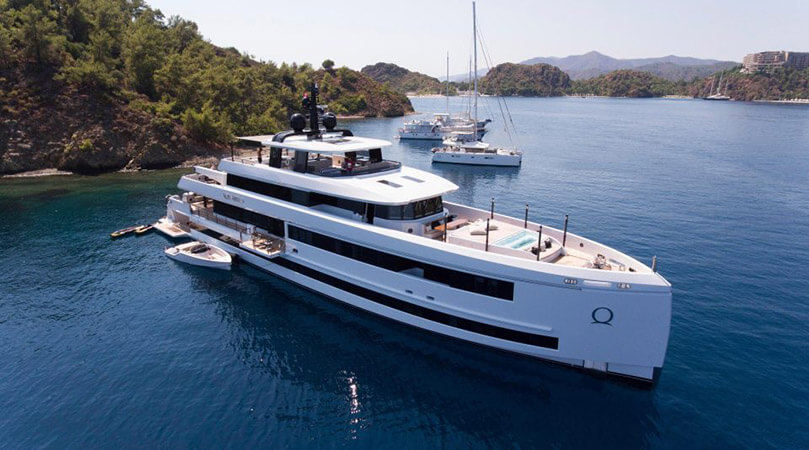
Imagine that you are contemplating possibly one of the biggest purchases of your life – a superyacht. One that will fit in with your desires, ambitions, tastes and lifestyle. A luxury floating residence that will, if you wish, take you to most places in the world. Whether this is real or merely a dream, you may now want to turn your attention to the all-important topic of what I will call ‘toys’; and what others may call essential accessories. These can be boiled down to two types. Those that enhance the sea-faring aspect of your superyacht and perhaps do deserve the moniker of ‘essential accessories’, and those whose primary purpose is to enhance your enjoyment of your purchase – and really do deserve being called ‘toys’. There are too many items to describe here, so what follows is merely a small selection of the ways in which you can spend / invest (you choose the term you prefer!) your money. So, which shall be considered first – the useful accessories or the toys? You guessed it – first we will consider some of the more expensive toys. The second part of this article will be slightly more down-to-earth and consider some useful accessories. Toys – going up Boats, as you may have noticed, tend to stay more or less at one level, namely at sea level. Therefore, we obviously need some toys that overcome this limitation – such as helicopters and submarines. Of the 771 Superyachts currently for sale, some 41 have a helipad. It must be admitted that you need a certain size of yacht, and wallet, to have a helipad. However, there is no doubting their convenience compared to a mere dinghy or tender. They are great if you want to explore an uncharted area or to pick up and welcome guests with a certain style. Of course, you need to consider a number of technical issues, such as the size and weight of the helicopters that will be supported, including possible refuelling issues. This whole area is – quite rightly – heavily regulated and subject to a number of survey, design, certification and important safety issues. In particular, a so-called ‘touch and go’ helipad is one that is explicitly excluded from some of the certification and other issues, but cannot be used for anything that could be regarded as commercial use. One essential question regarding helicopters is how many helipads do you need – one or two? Personally, I think that more than two helipads is just showing off and is somewhat vulgar! Helicopters can range from simple, relatively low-cost choppers such as the Robinson R22 to more complex, powerful ones with greater carrying capacity. Realistically, the very smallest machines may offer limited benefit as they will only carry one pilot and one passenger. Therefore 4 seaters upwards, with some capacity for luggage, should be considered the minimum that would be of realistic use. The type and size of helicopter supported is an important design consideration for your helipad. Another key factor is – are you going to actually store a helicopter on board, or merely use it so that others can land their choppers on your superyacht? If the former, you need to take into account storage space, spares, fuel, weight distribution and even the possible need for a hangar. The writer must confess to an interest here. He owns some 9 helicopters. In case you think this is somewhat extravagant, I would like to point out that the largest is only 5 feet long. They are housed in a small room in our house that my wife disparagingly calls the helicopter room. Toys – going down Let’s talk about exploring underneath the ocean levels. There are three ways to do this from your superyacht: Scuba diving Scuba, assisted by a motorised scooter Submarine The first method is simply to scuba dive. Training via a competent organisation such as PADI or BSAC is essential in order to do this safely. The constraints are that unless you use specialist equipment, you are limited to 35 metres below the water for 30 minutes with a medium level of training and experience. More than this requires specialist training and equipment, such as that associated with technical, trimix, diving. Trimix uses a mixture of three gases: oxygen, nitrogen and helium. I would suggest that any superyacht should contain some basic scuba kit, and trained personnel, so that any underwater issues with the vessel can safely be investigated without having to haul the boat out of the water. Just a word of warning. Don’t ever call the things you attach to your feet ‘flippers’. They are not, and any real scuba diver will have fun pointing out that the correct term is ‘fins’. Likewise, the tanks on your back are definitely not ‘oxygen tanks’. If they contained pure oxygen, they would kill you. For normal scuba diving they contain highly compressed air. If you want to scuba dive, but move faster or further, why not consider some motorised assistance? There are a number of diver propulsion vehicles (DPV), also known as an underwater propulsion vehicle or underwater scooters on the market. These battery driven devices pull you along underwater. They are very cheap, only costing several thousand UK pounds. (Hey, we are talking about superyachts here, so this is cheap in this context.) They help you go further, and possibly use less air as you are exerting yourself less. Also, most importantly, they are great toys. However, in reality, these systems will only ever move you at 2.5 to 3 knots maximum, so do not regard them as an underwater equivalent to a high-speed RIB. If you really want to do a lot more underwater and do some serious exploring, then you have no choice but to get your own mini-submarine, or ‘submersible’.
Deciding What You Want From Your Boat
Deciding what you want from your boat One of the challenges when buying a boat, especially if it is your first boat, is deciding what you want. At Go Earth, we call this process “Requirement Analysis” – a term unceremoniously nicked from project management and software development. Breadth of choice So – you know that you want to buy a boat – but what sort of boat? There are more varieties of boat than, say cars. This means that – if you are to make best use of your money and get a boat that you will enjoy for a long period – you need to give it some thought. Let’s look at some of the variety of choices you need to make. All cars, for example, have 4 wheels – unless you are Del Boy! (And for the younger readers, do a Google search on ‘Del Boy car’!!). Boats on the other hand can have one, 2, 3 or even more hulls. In fact some racing yachts hardly use their hulls, as they are on foils. What about motive power? In cars, the choice is between petrol, diesel and electric. However, they are all broadly similar in that their output is rotary power – turning wheels. The differences between the main ‘power units’ on a power boat (engines) and on a sailing yacht (sails) could not be more stark. What about Price range? Again, the differences are massive. No matter how hard you try, it is really very di ffi cult to spend more than (to take an extreme) £2 million on a car. It’s dead easy to do this for a boat. Trade-offs The main trade-offs to consider when purchasing a boat of any type are: Size Age Price Subsidiary trade-offs are Condition, including service history Brand Other factors, such as the inventory seem to pay only a very minor part. Sometimes, great electronics or the availability of a dinghy and engine may be a minor factor. As a purchaser, you need to decide on the relevant importance to you of these factors. Age matters In respect of these trade-offs, boat are similar to cars. The older the car, the cheaper it usually is. There are exceptions – some classic cars (what we used to call ‘old bangers’!) may appreciate in value. However, the general rule still applies – there is a depreciation curve showing how price falls at the boat gets older. At Go Earth we have records of asking, and sold, prices for many models; so let’s take one random example, the asking prices for a Fairline Targa 48. We did an analysis of average asking prices for this model, and this is what we found. Illustrative Prices – Fairline Targa 48 In the table, the first column is the year, the second is the asking price, and the third is the annual depreciation compared with a model a year younger. These prices may be only approximately typical, but they illustrate that (as with cars) the newer the boat the larger the depreciation hit. We find that once you get to the older boats, and if you buy wisely (using Go Earth’s negotiation services!), you can suffer zero depreciation for several years. Size matters There is, however, one big difference between cars and boats. Cars are all very broadly the same size. Even the largest SUV is probably only twice the size of the smallest micro car. The size difference in boats is immense. This leads to a major impact on price. As a very approximate rule-of-thumb, the price of a boat increases as the cube of its length (as a boat increase its size in all 3 dimensions). So, a boat that is twice the length of an other one, could be 8 times the cost. Given that all boats shrink when you put them in the water (yes, I know that does not literally happen – I just mean that a boat on hard-standing always looks bigger than when it is in the water), deciding on the size of boat is a very important part of the decision making around defining your requirements. Flybridge or Sports Cruiser? Let’s take just one specific example of the sort of decision you need to make. Suppose that you are in the market for, say, a power 38 to 42-footer. Two of the main styles of boat are flybridges and sports cruisers. Which suits you best? If you are going to do this comparison, it may be helpful to know the typical main characteristics of each type. This is a summary: Flybridge Depending on the brand, there may be a limited range of models. By having a flybridge, this usually gives you more overall deck space, as you have a deck on top. Easier to manoeuvre in a marina, as you can see mostly around you from the flybridge. Two helm positions. Arguably, more traditional looking. Need to cover the flybridge with a tonneau cover in inclement weather. Flybridge is a nice space to entertain in good weather. However, the steps up to the fl ybridge can be steep, though. Better view of the scenery and surroundings from the flybridge. Slightly more susceptible to side wind, owing to higher windage. Can make berthing the boat slightly trickier in open marinas with high wind Slightly more susceptible to side wind, owing to higher windage. Can make berthing the boat slightly trickier in open marinas with high wind Cruising in warm weather from the flybridge is very pleasant. At larger sizes, flybridges tend to be the most popular choices. Higher – therefore bridge clearance can be an issue, primarily in inland waterways. More expensive per foot length, owing to an extra deck (i.e. the flybridge); but possibly cheaper per square metre of deck space. Flybridges tend to have better galleys. Sports Cruiser Possibly a more extensive choice. Less deck space. Fixed point to steer from – possibly limited visibility at some angles. One helm position. Sleeker,