
Embracing Fender Technologies to Enhance Boating Experience
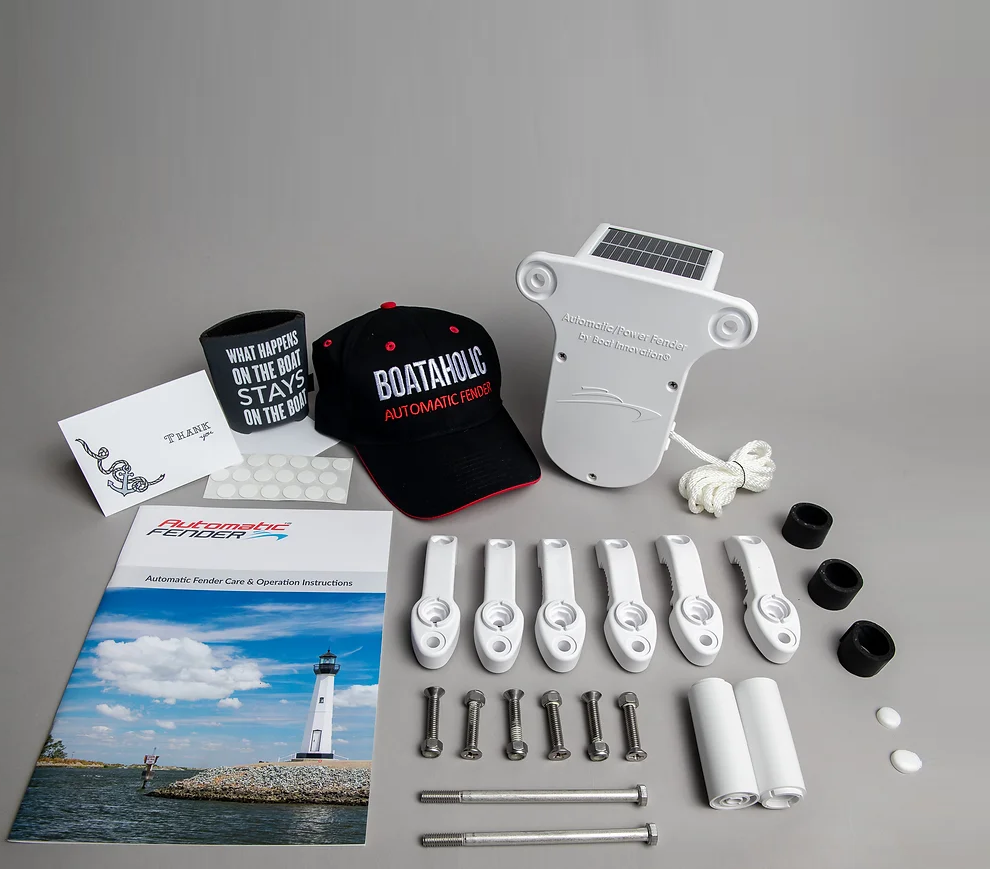
Boating has always been a blend of tradition, skill, and adventure. However, as technology continues to advance, it is worth it for boaters to embrace the latest innovations to enhance their yachting experience. We will explore the rise of fender technologies, and examine the role of a Fender System in facilitating safer, more effortless procedures for docking and undocking boats, thereby minimising the risk of unwanted impact damage to the boat. Some experienced boaters may say “I have been on boats long enough. We do things the way we always have, using our hands, our eyes and our instinct – that is what real boating is to me. Not some fancy technologies.” Long-time boaters often are not too quick to adopt new technology because they have years of practice and trust in the old-school ways of doing things. They reckon that sticking to what they know keeps the real spirit of boating alive, even though the technology could make their boating experience safer and easier. New Technology Broadens the Horizon in Boating Similar to the emergence of digital photography in the 1990s, there was initial resistance from professional photographers as they were deeply rooted in their established analogue techniques, and perceived this technological shift as a potential threat to the art. However, as time passed, they began to realise that digital cameras not only preserved the fundamental principles of photography but also expanded its scope, adding diversity and excitement to the craft while reducing cost. This flexibility ignited a resurgence of interest in the art, enabling professionals and amateurs to experiment with new styles without losing sight of basic photography theories and skills. Similarly, the Fender System enhances the pleasure of boating by facilitating safe docking and undocking procedures, while boaters continue to refine and utilise their boat manoeuvring skills. This increased safety measure reduces potential damage to the boat and relieves boaters’ stress during the process, hence enhancing the overall experience on the water. How Does It Help? We probably agree that docking a boat is quite challenging, as boat fenders are set to mitigate the unavoidable knocks and scrapes that might cause during docking and undocking. Naturally, it is always an unexpected gust of wind, a sudden turbulence on the sea surface, or an oversight that makes boat arrival and departure at a berth risky and even dangerous. Despite its usefulness, boat fenders come with complications for boaters, as they are bulky to store and inconvenient to use, not to mention the challenges of having a crew to position them correctly at the bow, especially in turbulent waters. The situation can be even more problematic for those who have limited mobility, or those who love sailing solo – the necessity to abandon the helm to deploy or lift fenders during the docking and undocking process is not only risky, but it could be an unwise course of action. The Fender System addresses all these challenges. Using smart sensing technology and remote monitoring & control, the system allows boaters to control boat fenders remotely from the cockpit when docking or undocking the boat, significantly reducing stress and effort, especially in dangerous situations. The system is notably easy to use. It has been designed for boaters to manage it from anywhere on the boat using a smartphone or tablet and a simple app. Powered by batteries that last a long time, the system comes with a waterproof casing so boaters do not have to worry about regular replacements. The installation of the Fender System is considerably simple by just screwing it on the boat rails using a suitable screwdriver. The Fender System is not just about making docking and undocking safer and more efficient, but also about keeping things neat. It also serves as a practical tool for novice boaters, allowing them to hone their sailing skills, while simultaneously enjoying sailing. The integration of traditional skills and the Fender System is paramount to enhancing the yachting experience. By embracing innovations, boaters can preserve their connection to the rich heritage of seamanship while enjoying the safety and convenience. Learn more about the latest version of our Fender System. Feel free to contact us for placing your order.
Is It A Good Deal?

Safety On Board You’ve probably see pictures or even videos of a boat on fire. It certainly is not a pretty sight and one that quite correctly puts fear – or at least caution – into your heart. There is no doubt that the best approach requires a combination of prevention, detection and first line firefighting. Let’s be clear – if a fibreglass boat is seriously on-fire, then ‘abandon ship’ might be your only option. Never put yourself or others at risk Prevention requires a common-sense but methodical approach. Carry out a Fire Risk Assessment – identify what could go wrong; and what you can do to prevent a fire from ever starting. For example, an absolute no smoking policy is the best approach. Also, be very careful of those gas lighters that are used to light a gas ring – they can still have a flame or be hot when placed on a surface or in a drawer, possibly starting a fire. Detection is quite straightforward. There are many low-cost smoke and fire alarms on the market. (Carbon monoxide alarms are also very important.) They are all easy to fit. We have used industrial strength ‘Velcro’ to affix alarms without drilling walls or ceilings. They seem to hold even in choppy seas. Placement is of course important. You need to have one in every ‘room’ in the boat. Don’t assume that fires only start in the galley. First-line firefighting is more complex. Some basic rules apply. Obviously, a pan-pan or mayday (or dial 999 if VHF is not available) is required. To safely extinguish a fire you need to get to it very quickly. It follows, therefore, that you need an extinguisher (even if just a small one) in easy reach in every room that is likely to be occupied (cabins, galley, saloon etc.). Also, always leave yourself an escape route. One risk occurs if you sleep in a forward berth. If a fire starts in the galley, then this may block a possible means of escape. However, opening the forward escape hatch above the berth also has a risk – of encouraging the fire by allowing a draft of air to fan the flames. This reinforces the need to have an extinguisher close to hand. The galley should of course also have a fire blanket. Be sure you know how to use it correctly to avoid burns to your hands. There is, however, one serious, well recognised problem with the common powder type of fire extinguisher. If they have to be used, they make a truly horrendous mess. Unfortunately, they get into all the soft furnishings, they corrode electric and electronic connections, they are potentially toxic if breathed in, they act as a laxative (!!), they can be destructive of engines. The mess can only be safely cleared up using personal protective gear. Go Earth researched this problem and found two ranges of extinguishers (Firetool for inside spaces and Blazecut for the engine bay) that do not suffer from these issues.
Fire Safety on Boats
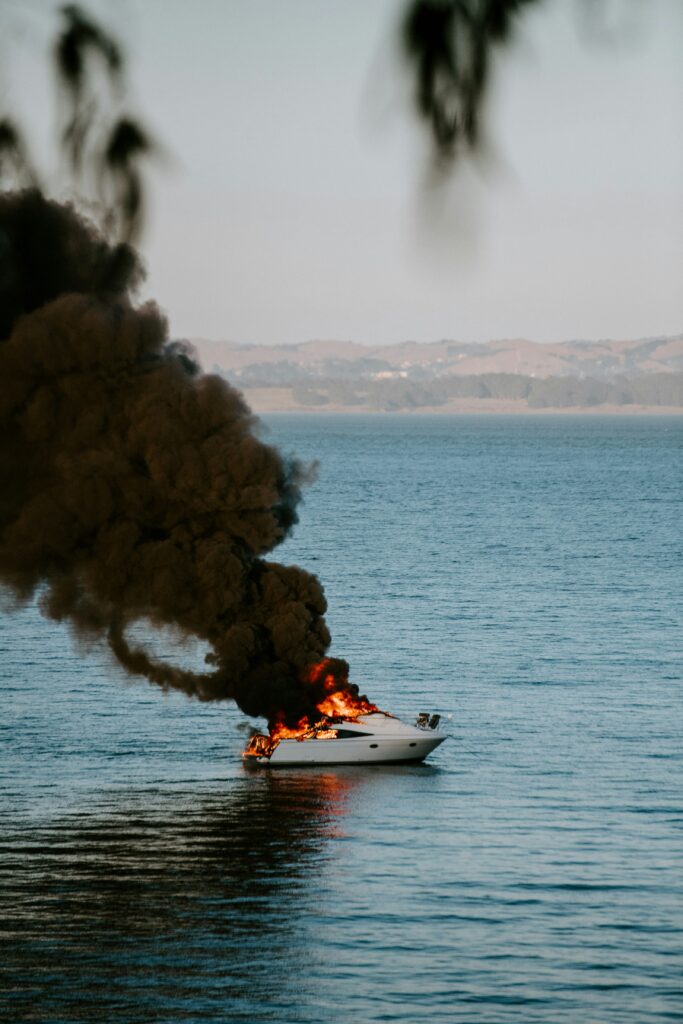
You’ve probably seen pictures or even videos of a boat on fire. It certainly is not a pretty sight and one that quite correctly puts fear – or at least caution – into your heart. There is no doubt that the best approach requires a combination of prevention, detection and first line firefighting. Let’s be clear – if a fibreglass boat is seriously on-fire, then ‘abandon ship’ might be your only option. Never put yourself or others at risk. Prevention requires a common-sense but methodical approach. Carry out a Fire Risk Assessment – identify what could go wrong; and what you can do to prevent a fire from ever starting. For example, an absolute no smoking policy is the best approach. Also, be very careful of those gas lighters that are used to light a gas ring – they can still have a flame or be hot when placed on a surface or in a drawer, possibly starting a fire. Detection is quite straightforward. There are many low-cost smoke and fire alarms on the market. (Carbon monoxide alarms are also very important.) They are all easy to fit. We have used industrial strength ‘Velcro’ to affix alarms without drilling walls or ceilings. They seem to hold even in choppy seas. Placement is of course important. You need to have one in every ‘room’ in the boat. Don’t assume that fires only start in the galley. First-line firefighting is more complex. Some basic rules apply. Obviously, a pan-pan or mayday (or dial 999/112 if VHF is not available) is required. To safely extinguish a fire you need to get to it very quickly. It follows, therefore, that you need an extinguisher (even if just a small one) in easy reach in every room that is likely to be occupied (cabins, galley, saloon etc.). Always leave yourself an escape route. One risk occurs if you sleep in a forward berth. If a fire starts in the galley, then this may block a possible means of escape. However, opening the forward escape hatch above the berth also has a risk – of encouraging the fire by allowing a draft of air to fan the flames. This reinforces the need to have an extinguisher close to hand. The galley should of course also have a fire blanket. Be sure you know how to use it correctly to avoid burns to your hands. There is, however, one serious, well recognised problem with the common powder type of fire extinguisher. If they have to be used, they make a truly horrendous mess. Unfortunately, they get into all the soft furnishings, they corrode electric and electronic connections, they are potentially toxic if breathed in, they act as a laxative, they can be destructive of engines. The mess can only be safely cleared up using personal protective gear. Go Earth Boating researched this problem and found two ranges of extinguishers (Firetool for inside spaces and Blazecut for the engine bay) that do not suffer from these issues.
An Interview with Boat Trader
The leisure marine industry has many different companies in many sectors selling a wide variety of goods and services to boaters and potential boaters. In this special interview, we talk to Boat Trader and explain why ‘Go Earth does it differently’. Something different Boat Trader: Martin, can you tell us a bit about why you started Go Earth Martin: There are two main elements to this; a link with the water and wanting to do something different – some ‘thinking outside the box’ – if you will forgive the cliché! Firstly, we have had a link to the water in one form or another for many years. We been boaters ourselves for over two decades, and I have been a scuba diver for four decades. Our daughter and son-in-law are both qualified PADI scuba diver instructors. I am also a dinghy sailor – or at least attempting to be! So, we got to know the vast variety of companies in the broad leisure marine industry. Next we decided to form a company – with something to do with boating. Initially we were not sure what exactly was wanted. One thing we were sure of – we did not want to do the same as everybody else. In a nutshell, we wanted to do something different that would ‘add value’ to the boating community. Boat Trader: What do you mean by ‘something different’? The art, craft and science of boat buying Martin: Frankly, at first we were not sure. So, we indulged in (cliché alert!!) some out of the box, blue-sky thinking. (Well, I did warn you about the clichés!) What we eventually realised was that we needed to do things that were of genuine value to boaters, which were not currently being done, and which we could deliver successfully. We did not want to be just another chandlery or another boat sales company or another training school. One thing that we kept on hearing was of people who were not quite sure what they wanted when they were buying a boat and how to go through the whole process. Brokers help, of course. However, they have to act for the seller, not the buyer. Therefore, a key element of our business is helping people with buying a boat, acting on behalf of the buyer, not the seller. Boat Trader: How do you do this? Martin: By becoming experts in boat buying. The concept is simple enough. Most people only buy one, two or three boats in their lifetime. They simply do not do it often enough to know all the things that should be considered when buying a boat. We go through the process time and time again with multiple clients, multiple brokers and multiple types of boats. As a company, we aim to be the expert ‘port of call’ (another cliché ?) for boat buyers. Requirements analysis Boat Trader: Is that all there is to it? Martin: No, not quite! As well as expertise, you need processes, tools and data to support the activity. As an example of a process, for our boat search, we typically spend some time with the client developing a ‘Requirements Analysis’. We talk to the client, find out what they are looking for, offer advice, and iteratively develop and improve the requirements analysis. This does require a bit of time and work up front; but – very importantly – it helps ensure that the client ends up with a boat that really does suit them and their needs. Note that this is the polar opposite of ‘Oh –I have just seen a nice boat – let’s buy it’. We start with the client, not the boat! Boat Trader: So the first step is the requirements analysis. What do you mean by iteratively? Martin: Sometimes, the client is not quite sure what they want. So – in our enhanced service – we might for example develop a requirements analysis, then do a boat search. After getting our written report, the client will think about it, might develop their thinking further, and might realise that they need something slightly different, or simply change their mind about some aspects of their requirements, or have a change in the budget they are willing to spend. We then (at absolutely no extra charge) change the requirements analysis and re-run the search for them. Boat Trader: What if they change their mind again? Martin: No problem. With the enhanced search, we will run the requirements analysis / boat search a third time, again at absolutely no extra charge. The important thing for us is that the client should not be locked into their initial thoughts. We want them to end up with a boat that really does suit their needs. Software tools Boat Trader: Earlier on, you mentioned that you used some ‘tools’ in your work. Martin: One of the tools that we use is some software that we developed in house. It holds an enormous database of brokers and others – UK and global – covering a vast range of budgets, boat types, locations and so on. During a boat search, we can input some key parameters from the requirements analysis and use that to query the database to identify the brokers that are likely to have boats that match the requirements. This database also includes, for example, user forums that sell boats, brokers who don’t advertise on the internet, some private sources, some not-so-well-known auction sites and so on. If you are searching for a superyacht, then you clearly need to focus on those brokers, not ones selling, say, narrowboats or river boats. The software helps us to this effectively and efficiently. Data Boat Trader: What about the ‘data’ bit? Martin: Easy – We accumulate masses of data inside our software. We use that